No
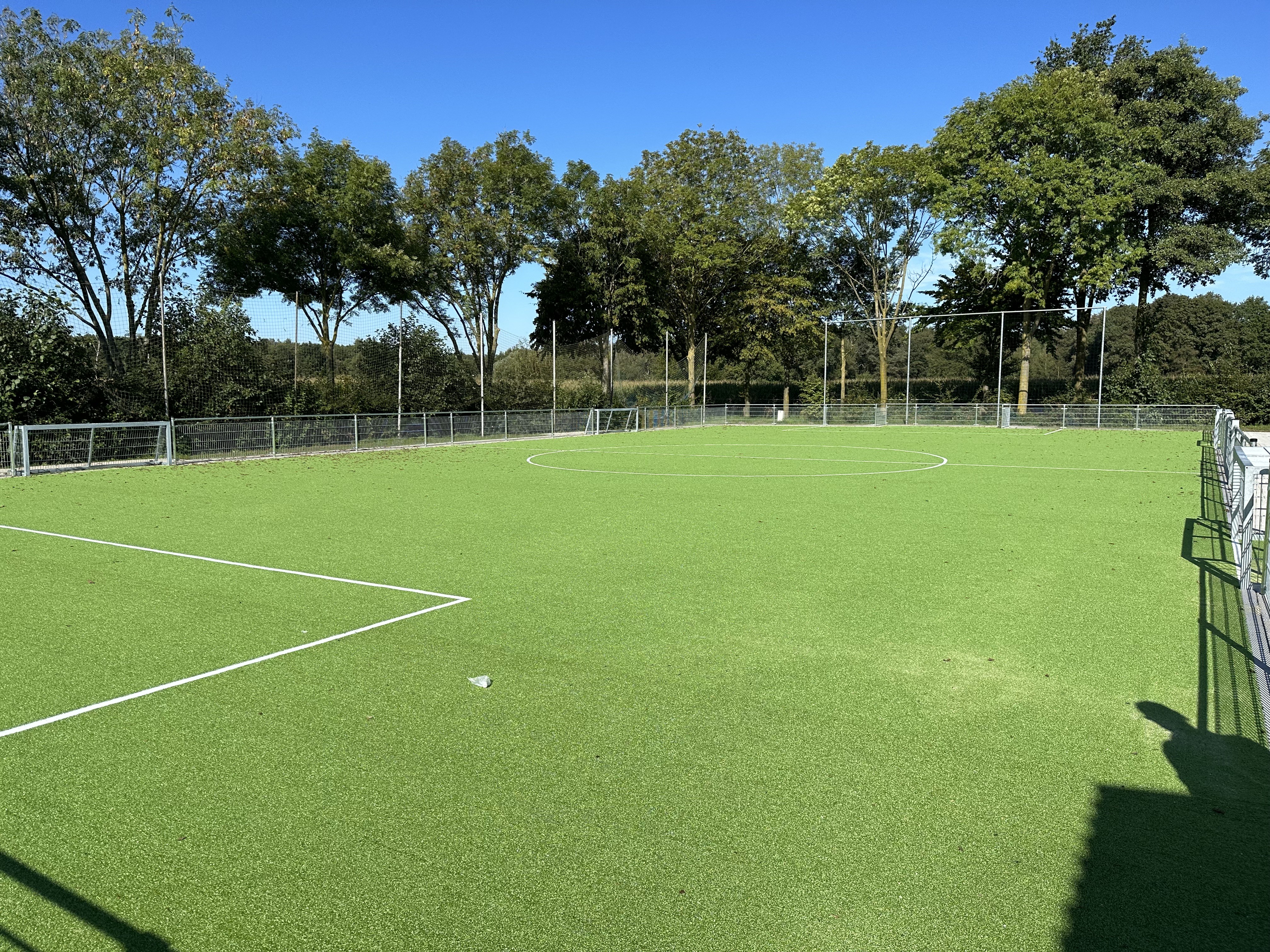
800 square meters of multipurpose pitch at the football club RKVV Dommelen in Valkenswaard, the Netherlands being used for football and school sports.
The 800 square meters of multipurpose pitch is using Circular Turf Systems (CTS) technology. That is the first fully polyester pitch with this technology backing, coating, and fibre. It is installed on a panel structure with a depth of 7 cm with a horizontal flow.
By using a panel as a base construction, we solve 2 main environmental issues. We do not suffer anymore from frost heave, so we can reduce the depth from 50 cm to 10 cm. Reducing the carbon footprint with 3000M3 of soil transportation. The second advantage is that we can reuse 20.000 sqm 30.000 Kg of old artificial turf in the construction of a new football pitch.
Circular Turf Systems (CTS) by RSI Sports Group introduces the first fully closed-loop artificial turf system, designed for full reuse. The entire turf layer is made from 100 PET, including yarns, backing, and glue tape. This allows the turf to be restored and reused to make turf again, without losing performance or quality.
CTS is a complete system, not just a recyclable surface. It combines reusable turf with modular base panels made from reclaimed end-of-life turf, along with organic infills and carbon-sequestering olivine sand. Each field installation reuses material from multiple old pitches, removing waste from the system at scale. CTS meets top sports performance standards and has been accepted into the FIFA Innovation Programme, proving that full circularity in artificial turf is practical, scalable, and ready for real-world use.
Technical innovation
The initial cost difference between a normal pitch and a fully CTS pitch is about 10-15 on the total investment. At the end of the life cycle that is gained since the pitch becomes a raw material instead of a waste.
We are the winners of the SBIR program of RVO challenging the industry to come up with a solution for the end-of-life problem. A national challenge. The total amount of the tender (not a grant) was appr 750.000 and was about 40 of the final cost.
The savings on end of life are appr. 10%
We solve the end-of-life problem of artificial turf in 2 ways. First, by using a 100 polyester pitch, which can be 100 recycled in new artificial turf, we close the loop as per the 2030-2050 SDG goals.
So, we solve the end-of-life problem of football turf in the future, we have a solution for the existing football turfs, and we reduce the material and transport impact by reducing the amount of material needed.
Sport facilities need to be convinced in the TCO thinking since these types of pitches with a higher grade of recyclable plastic have a higher investment up front and lower TCO.
Hence, sometimes an uphill battle despite the difference being only 10-15 of the total sum.
| Indicator | Value |
|---|---|
| Visits per year | Hundreds of children use the pitch for football training and sports |
| Water Consumption (liters/use) | nan |
| Primary energy Usage per year (kWh/use) | nan |
| Estimation of Water Saving (%) | |
| Estimation of Energy Saving (%) | |
| Estimation Waste and Resource Savings (%) | High (more than 70%) |
Compared to traditional build up 80 of materials being used. Holistically seen in the assumption that this pitch will be rebuild with the very same materials another 70 in turf in 10 years time.
Not specified.
Last update: March 2, 2026, 3:10 p.m.