
Yes
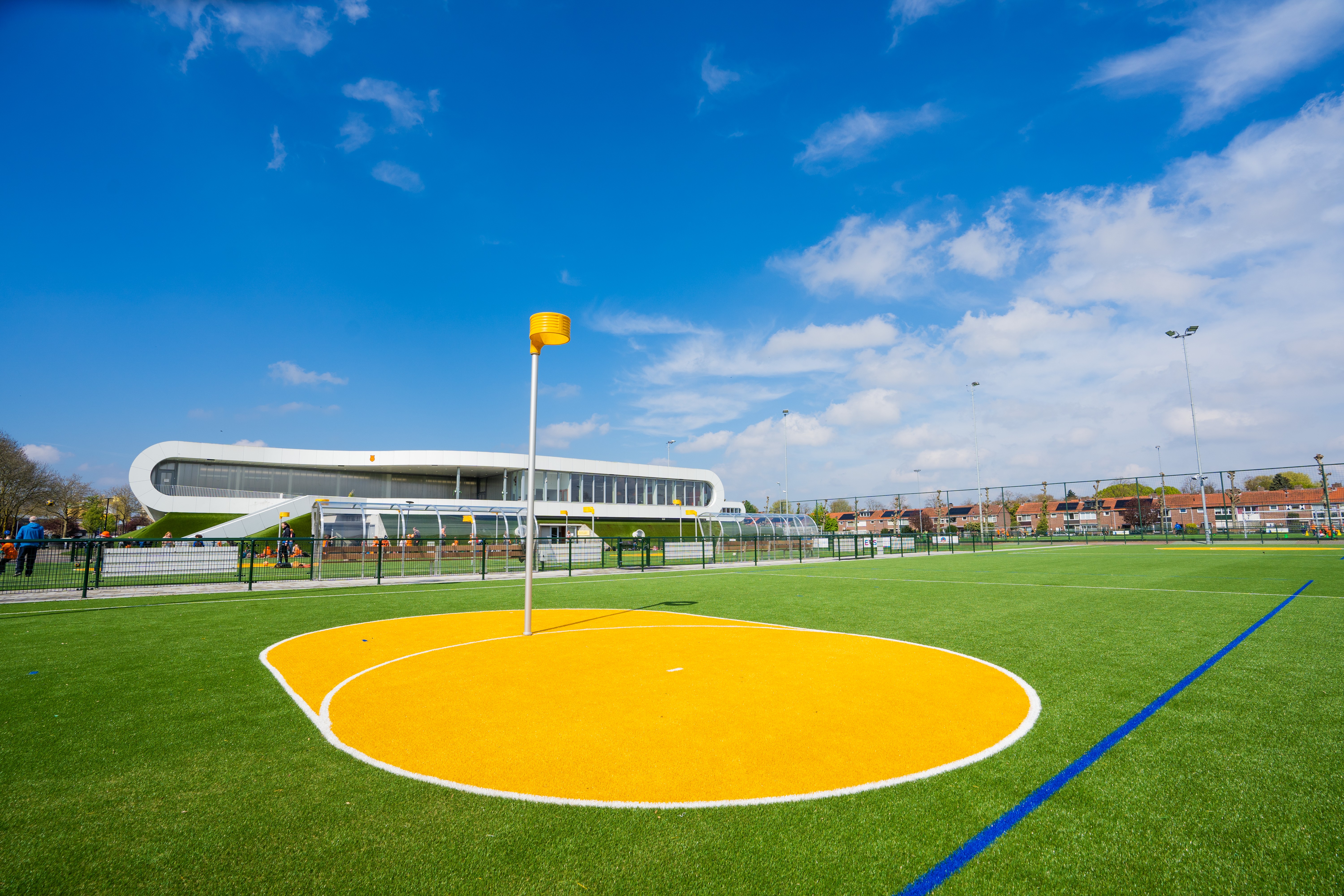
This multifunctional sports park features modern facilities. It is located next to the Christiaan Huygens College in Eindhoven. The tennis courts are rented by Tennis Club Engelsbergen. The sports complex consists of football fields (2 grass, 2 artificial grass) 2 korfball fields (1 artificial turf field with 3 fields, 1 grass) 2 handball fields 3 all-weather tennis courts Suitable for recreational use and training Wheelchair-accessible toilet available
In early 2023, a collector field was installed under the artificial turf sports field at Sportpark Strijp. This field is connected to the municipal thermal energy storage system and provides sustainable heat that can be used to heat and cool homes in the future.
This is unique in the Netherlands nowhere else has the combination of collectors and ground storage been used in this way. Multifunctional means that the top layer can be used for multiple sports, increasing the fields occupancy rate. A collector field is installed beneath the artificial turf. This is connected to the existing municipal aquifer thermal energy storage system (WKO). This could potentially heat approximately 100-150 homes in the future.
The collector field is installed beneath the top layer of the artificial turf pitch. Pipes are installed there in special tiles (called the collector field). A cold fluid flows through these pipes. This fluid absorbs the heat and is stored in the ground in the municipal thermal energy storage (WKO). The WKO system has the potential to heat at least 180 homes. Besides heat storage, this also keeps the pitch considerably cooler in the summer.
Technical innovation
The municipality invested 480.000 in this collectorfield. This is purely the collectorfield system and not the top sport layer.
National Local Heat Transition Program is a Dutch subsidiary for municipality to learn how to make the built environment gasfree. This is a 4.6 million can be used if we make approximately 500 dwelling natural gas free.
Depending on the additional cost for the heating district network to the dwellings this ROI can be determined.
The multifunctional use of the field creates added value. There is enormous potential to use sports fields to help make the built environment free of natural gas.
It allows athletes to exercise in cooler conditions, as the field is cooled during the summer.
Contributing to the sustainability of the energy supply and potentially reducing the energy costs for sports clubs.
The technology is not yet fully proven, so you have to take into account additional learning costs and development risks.
The required sports performance standards must be carefully assessed.
The product still involves a lot of manual work, making the system not yet vandalism-proof. Users must consider the unique nature of the system, for example, by avoiding anchoring objects in the field.
| Indicator | Value |
|---|---|
| Visits per year | 100 000 |
| Water Consumption (liters/use) | N/A |
| Primary energy Usage per year (kWh/use) | 2.0 |
| Estimation of Water Saving (%) | |
| Estimation of Energy Saving (%) | High (more than 70%) |
| Estimation Waste and Resource Savings (%) |
The estimated energy gains are 0.4 0.8 GJ m2 per year. For this field it is 1600-3200 GJ per year. In our situation the gained heat will be used for the neighbourhood and not for the facility as that facility was already gas free. But in general the expected saving is hopefully more than 70.
Make a feasible business case for the collector field including the heating district network to the neighbourhood.

Last update: March 2, 2026, 3:09 p.m.